Introduction
Gear machining in the traditional process can easily lead to such problems as low efficiency, cost overrun, and inadequate precision in manufacturing, causing project delays and waste. Unscientific process selection could bring about a reduction in transmission efficiency by 20% and shorten the life of gears by 50%. The root of these challenges is reliance on outdated methods with a lack of support in data-driven decisions, which hinders dynamic optimization of parameters for processes.
The following article discusses how custom gear manufacturing incorporates data-driven methods to balance precision with efficiency, referring to ISO 9001 and similar standards that assure reliability. This section provides an overview of the key strategies that have been adopted to systematically address manufacturing bottlenecks.
What are the common pitfalls in traditional gear machining processes?
Traditional gear machining processes have a number of inefficiencies associated with them that make them difficult to achieve project success. In this section, typical problems such as thermal deformation and tool wear are analyzed, underlining the role of material science in predicting issues.
1. Thermal Deformation and Precision Loss
One of the factors accountable for precision loss in gears is thermal deformation in machining. When temperatures rise due to machining, there are chances of material deformation, which may result in the loss of dimensions of the material. High temperatures, for example, in the case of high-speed gears, may deform gears, causing misalignment, which further leads to a loss of transmission efficiency. An example ofNIST materials data is presented in the explanation of how material science works in determining these deformations based on thermal expansion coefficients.
2. Tool Wear and Cost Escalation
Excessive tool wear can also lead to high operational costs and reduced quality of the gear manufactured. As the tools age, their cuts tend to vary in quality, resulting in defects and dimensional accuracy problems for manufactured gears. As a result, manufacturers tend to replace their tools frequently, which inculcates additional high costs. Data-driven strategies in manufacturing can effectively identify tool maintenance based on the wears and tears, preventing additional tool costs as much as possible. This was reflected in a study that found that predictive maintenance can reduce tool costs for manufacturing gears up to 30%.
3. Inefficiencies in Process Selection
Unoptimal process choice can result from inadequate interaction and integration with contemporary database systems. Modern process choice employs generic parameters, which can prove ineffective in particular gear-driven applications, thus contributing to project delays and repeated work. Through the effective use of custom gear manufacturing processes based on simulation and past experience, it is now possible for engineers to make the best choices in processes such as hobbing or grinding through data-informed analyses designed for optimal project output and reduced errors.
How Does Data-Driven Custom Gear Manufacturing Improve Efficiency?
Data-driven custom gear production optimizes efficiency by utilizing large databases and analytics. Various ways in which process optimization and quality systems impact efficiency are discussed in this section.
- Optimization of Transmission Efficiency: By using data-driven process selection, producers are able to reach the efficiencies of over 98.5% in transmissions. By understanding variables such as load characteristics and material type, customized processes optimize gear configuration according to requirements, thereby minimizing losses in energy. For example, based on algorithms to model gear meshing, detailed customization of gear teeth is achieved to reduce friction and wear, thereby maximizing efficiency while being compliant with ISO 9001 norms in quality control processes.
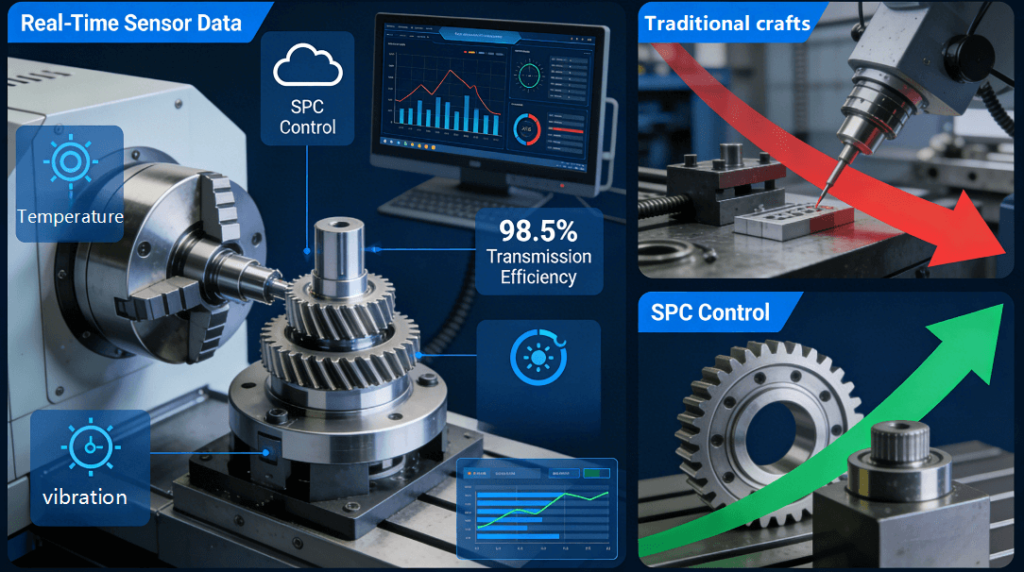
- Reduction of Waste and Costs: More efficient use of materials diminishes the amount of waste produced by custom manufacturing. For instance, adaptive machining involves altering real-time process parameters based on sensor inputs to eliminate cutting more than necessary. A manufacturer was able to decrease its costs by 25% for materials by applying data-driven workflows, explaining how optimizing for efficiency translates to sustainable methods.
- Integration with Quality Management Systems: The integration of ISO 9001-certified systems into data-driven processes allows efficiency to be maintained over time. The ISO 9001 system has established frameworks in continuous improvement techniques like auditing and feedback systems to identify bottlenecks. The integration of quality checks in the manufacture cycle helps businesses increase efficiency in gear machining processes; hence, gear machining process selection plays an important role in business success.
What Role Does CNC Gear Machining Play in Achieving High Precision?
In gear machining services, the gear machining process is crucial for achieving micron-level precision in custom gears. The following section will discuss advanced technologies in five-axis machining and process control and their impact on machining accuracy.
1. Advances in 5-Axis Machining
5-axis CNC machines are capable of complex gear designs with tight tolerance levels, including ±0.005mm for robotic RV reducers. This is because these machines are able to vary their tool paths continually, thereby avoiding the need for multiple setups with their corresponding errors. For instance, tech innovations for precision manufacturing are achieved through 5-axis machining used in the aerospace industry with its high-quality gear surface finish.
2. Real-Time Monitoring & Control
Real-time SPC (Statistical Process Control) in CNC systems ensures quality by examining crucial factors such as the location of the tool and the cutting forces. It enables immediate correction and prevents deviations in quality. On the other hand, manufacturers observed a 40% improvement in precision using CNC gear machining with the integration of SPC.
3. Benefits for High-Tolerance Applications
The use of CNC for gear machining serves several purposes, primarily for applications demanding strict tolerance. Such applications include medical equipment, for example, surgical robots, and auto parts. The use of surgical robots, for example, demands precise gears, and the application of CNC equipment for such tasks is achieved by computer simulation.
Raising Doubts about the Validity of Certified Quality like ISO 9001 in Gearing
Another area that is also important in regards to gear reliability is quality certification in ISO 9001. The next section will describe how quality certification can help reduce the failure of gears in critical industries.
1. Standardization of Manufacturing Processes
ISO 9001 certification ensures that the production flow follows strict procedures that will eliminate variation during the gear production process. This ensures that the gears are produced within the set tolerance levels. For instance, the automotive industry has seen a reduction of up to 20% in the failure rate of gears due to the implementation of ISO 9001 processes.
2. Traceability and the Regulatory Environment
Certifications ensure full traceability from the material to the final gear products, which can actually benefit industries such as the aerospace or medical business. This allows for rapid identification in cases of defects or recalling products if necessary. Drawing examples from ISO 9001, companies can state compliance with international standards, giving customers confidence in their products, thus easily accessing lucrative projects.
3. Customer Confidence Improvement
By going through certification processes, the manufacturer creates customer confidence in the products through demonstration of commitment to quality. For example, gears produced following ISO 9001 standards undergo rigorous testing, and this makes them more durable and of higher performance, thus reducing the possibility of claims for warranties while establishing the manufacturer as the best in precision manufacturing.
What are the main steps for choosing appropriate gear machining processes?
Choosing the best gear machining technique depends on a systematic process that involves various factors depending on the desired use of the gear. This section highlights the steps to take depending on the load capacity and production rate.
- Assessing Load and Precision Requirements: The first step in this process involves determining the load requirements and the required precision based on torque values and other parameters. In the case of high-load systems, powder metallurgy can be used due to its high strength properties because precision forging is used in high-volume production. ASME Y14.5 guidelines can be used for effective tolerance management in this process.
- Evaluating Production Volume and Cost: The number of production units directly relates to the technology of choice: for low production volumes, flexibility is provided by 5-axis CNC machines because of low tooling expenses involved, whereas for large series production, hobbing is preferred for the economy of scale. A gear machining technology selection tool is beneficial for selecting options that suit budget limitations without compromising on ‘quality’: for prototypes, custom technologies resulted in a production cost savings of 35%.
- Incorporating Sustainability and Efficiency: Sustainable practices in the manufacturing sector are gaining prominence. The choice of methods should be guided by energy usage and waste management. For example, near-net-shape processes can largely prevent material wastage, thereby aiding eco-friendly projects through the application of the aforementioned industry solutions in the industry sector.
What Role Does Advanced Gear Manufacturing Play in Business Expansion?
High-quality gear manufacturing equipment contributes to business growth in terms of quality improvement and efficient production processes. The next section summarizes advantages achieved through precision manufacturing.
1. Innovation in Boosting Productivity
Gear manufacturing innovations like AI optimization will improve productivity as it cuts production cycles and improves accuracy. For example, firms using advanced CNC machinery experience a 15% rise in production output, thereby directly helping in business growth tips because of fast turnaround times to market and increased customer satisfaction.服务
2. Reducing Scrap Rates and Improving Profitability
By introducing custom fabrication methodologies, the scrap can be reduced to a significant extent. In the case study, there was a reduction in scrap by 15% by continuous monitoring, thus increasing the profitability. It not only reduces the overheads, but also helps in increasing the resource-efficient solutions related to the machining of gears, thus making it the prime mover for its development.
3. Leverage Comprehensive Manufacturing Solutions
To reap the full benefit, companies should investigate full-scale manufacturing solutions that incorporate design, manufacture, and quality assurance. To illustrate, collaborating with quality-approved suppliers will help with full project support, also promoting fast-track project development and innovations. This focus further exemplifies how custom gear manufacturing is a growth trigger.
Conclusion
Custom gear production, having adopted data-driven approaches and certifications, overcomes successfully the precision and efficiency limitations of conventional processes. Relying upon technologies such as CNC machining and abiding by standards like ISO 9001, this ensures productive outcomes that are free from any hold-ups and expenses. Such processes not only improve gear performance but also put organizations on track for long-term success.
FAQs
Q: How is standard gear production different from custom gear production?
A: The standard gear production involves general processes for mass production in gear making, which may involve compromise on precision. The custom gear production involves tailoring processes such as CNC machining based on specific requirements, which ensures higher efficiency and durability as proved by the ISO standards.
Q: In what ways does data-driven process choice benefit gear life?
A: Through analysis of historical test data of thousands of parts, data-driven solutions have enabled determination of optimal values of parameters related to fatiguestrength and surface finish, which have resulted in reduced distortions and wear, thereby increasing gear life by over 50% for the aero and auto sectors.
Q: In precise gear production, what certifications matter most?
A: Quality management system certification like ISO 9001 or its automotive counterpart IATF 16949 helps ensure traceable processes. This helps to ensure high levels of AGMA 12 precision and reduces failure rates. The majority of its current applications are classified as mission critical.
Q: Can custom gear production ever be an economically viable alternative with small production runs?
A: Yes, with flexible technologies like 5-axis CNC machining, specialized manufacturing will not have large tooling expenses for prototyping or short productions. The cost-efficient manufacturing of 50 to 500 pieces can be assured with precision; therefore, this is suitable for R&D or special applications.
Q: How do environmental factors influence gear machining choices?
A: Temperature and corrosion are just some of the factors that require special processes, such as vacuum carburizing, for example, in aerospace gears. Data-driven simulation predicts distortion and thereby allows compensatory measures to be taken according to EPA guidelines on sustainable manufacturing.
Author Bio
The author is an expert in precision manufacturing with many years of experience in gear manufacturing process development. LS Manufacturing, a quality-driven supplier, holds international certifications such as ISO 9001, ISO 16949, and AS9100D, and can provide reliable solutions for complex engineering challenges. Want to learn more about them or optimize your project? Contact them now for a free quote and process guide — no need to search any further!